Losing multiple teeth—or even all of your teeth—can have a significant impact on your ability to eat, speak, and smile with confidence.
For many people, traditional removable dentures no longer provide the comfort or stability they need. Fortunately, advances in implant dentistry now allow many patients to replace an entire arch of missing teeth with implant-supported solutions that feel more secure and function more like natural teeth.
However, replacing all of your teeth is not simply a matter of placing several implants.
Successful full-arch rehabilitation requires careful evaluation of your bone condition, overall health, bite stability, and long-term treatment goals. Different treatment options are available, and each offers its own advantages depending on your individual clinical situation.
Can Dental Implants Replace All Teeth?
Yes. Modern implant dentistry offers several predictable ways to replace an entire upper arch, lower arch, or both arches using dental implants.
Rather than replacing each missing tooth individually, full-arch treatment strategically places a limited number of implants to support a complete set of replacement teeth.
The primary goals of treatment are to restore:
- Comfortable chewing function
- Natural-looking aesthetics
- Proper bite stability
- Facial support
- Long-term oral health
Today’s full-arch solutions can often provide significantly greater comfort and stability than conventional removable dentures while helping patients regain confidence in everyday activities.
What Are Full-Arch Dental Implants?
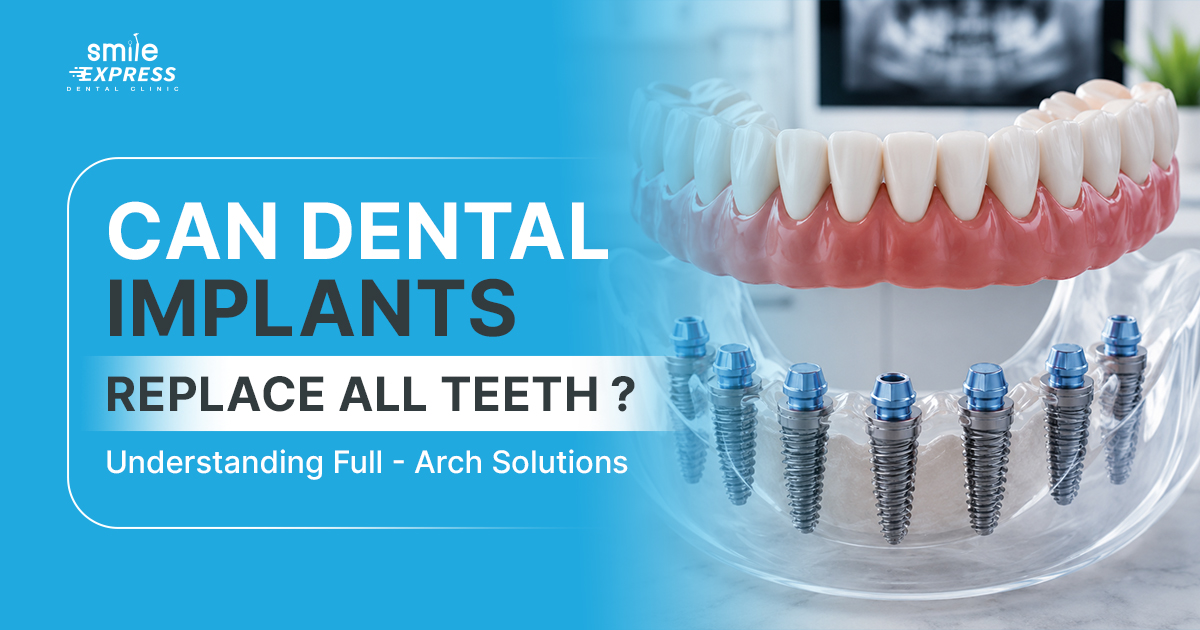
Full-arch dental implants replace an entire row of missing or failing teeth using implants that support a fixed or removable prosthesis.
Instead of placing one implant for every missing tooth, a carefully planned number of implants are positioned strategically to support a complete restoration.
Depending on your oral condition, treatment goals, and available bone, your dentist may recommend:
- All-on-4
- All-on-6 (or more implants)
- Implant-retained overdentures
Each approach is designed to improve chewing efficiency, restore facial support, and provide greater stability than traditional dentures.
Full-Arch Treatment Options
Several treatment options are available for replacing all of your teeth with dental implants.
Option 1 – All-on-4 Dental Implants
All-on-4 is one of the most widely used full-arch implant techniques.
The procedure uses four strategically positioned dental implants to support a full arch of fixed replacement teeth.
To maximise stability, the two posterior implants are typically placed at an angle. This approach allows many patients with reduced bone volume to receive implant treatment while avoiding more extensive bone grafting procedures.
Some of the key advantages of All-on-4 include:
- Fewer implants required
- Strong support for a full arch of teeth
- May reduce the need for bone grafting in suitable cases
- Immediate provisional teeth may be possible on the day of surgery
- Fixed (non-removable) restoration for improved confidence
Because implant placement must be highly accurate, comprehensive digital planning and careful case selection are essential for successful long-term results.
Option 2 – Implant-Supported Fixed Bridge (All-on-6 or More)
For patients with sufficient bone volume, placing six or more implants per arch may provide additional support for the final restoration.
Increasing the number of implants can improve load distribution across the jaw, reduce stress on each individual implant, and enhance long-term structural stability.
This approach is often recommended for patients who:
- Have excellent bone support
- Require maximum long-term durability
- Have higher bite forces
- Are suitable candidates for more comprehensive implant rehabilitation
Although more implants do not automatically produce better results, they may provide important biomechanical advantages in selected clinical situations.
Option 3 – Implant-Retained Overdentures
Implant-retained overdentures are another full-arch treatment option for patients who want improved stability compared to traditional dentures but prefer a removable restoration.
Instead of resting entirely on the gums, the denture attaches securely to dental implants using a specialised attachment system. This provides greater retention while still allowing the prosthesis to be removed for cleaning.
Some of the advantages of implant-retained overdentures include:
- Improved stability compared with conventional dentures
- Lower treatment cost than fixed full-arch implant bridges
- Easier daily cleaning and maintenance
- Better chewing efficiency than traditional removable dentures
However, because the prosthesis remains removable, it may not feel as natural or stable as a fixed implant-supported bridge.
The most appropriate option depends on your oral condition, bone availability, lifestyle, and personal preferences.
Which Full-Arch Solution Is Right for You?
There is no single treatment that is ideal for every patient.
The most suitable full-arch solution depends on several factors, including bone quantity, overall health, functional requirements, budget, and personal expectations.
The following table provides a general comparison.
| Your Priority | Recommended Option |
|---|---|
| Fixed teeth with fewer implants | All-on-4 |
| Maximum long-term stability | All-on-6 (or More) |
| Limited treatment budget | Implant-Retained Overdenture |
| Moderate bone loss | All-on-4 (when clinically appropriate) |
| Easier removal for cleaning | Implant-Retained Overdenture |
A comprehensive clinical examination and digital treatment planning are essential before selecting the most appropriate solution.
Who Is a Good Candidate for Full-Arch Dental Implants?
Full-arch implant treatment may be recommended for patients who have:
- Multiple missing teeth
- Multiple failing teeth that cannot be predictably restored
- Unstable or poorly fitting dentures
- Repeated failure of crowns or bridges
- Advanced periodontal (gum) disease affecting many teeth
However, suitability depends on much more than the condition of the teeth alone.
Your dentist will evaluate several important factors before recommending treatment.
Frequently Asked Questions
Is All-on-4 better than All-on-6?
Not necessarily. All-on-4 uses fewer implants and may be suitable for patients with moderate bone loss, while All-on-6 provides greater load distribution and may offer additional long-term stability for patients with sufficient bone volume.
How long do full-arch dental implants last?
Dental implants are designed as a long-term solution. With successful bone integration, good oral hygiene, and regular professional maintenance, implants can often last for decades. However, prosthetic components may occasionally require maintenance or replacement over time.
Will I receive teeth immediately after implant surgery?
In many cases, yes. Patients may receive a temporary (provisional) restoration shortly after implant placement, allowing them to smile and function during the healing phase.
The permanent prosthesis is usually fitted after the implants have fully integrated with the jawbone.
Do full-arch implants require maintenance?
Yes. Although implants cannot develop cavities, they still require excellent oral hygiene, regular dental check-ups, and professional maintenance to protect the surrounding tissues and maximise long-term success.
Thinking about replacing all of your teeth with dental implants?
Our experienced implant dentists can assess your oral health, review your CBCT scan or dental X-rays, and recommend the most suitable full-arch solution based on your bone condition, medical history, and long-term goals.
Whether you’re considering All-on-4, All-on-6, or an implant-retained overdenture, we’ll create a personalised treatment plan that prioritises long-term function, aesthetics, and stability. Book a consultation Today : https://www.smileexpressdental.com/contact-us/